

Change is hard and something that is common for many of us at work right now. As a leader, often you feel and need to navigate these changes before anyone else.
You’re expected to stay calm, bring clarity, support your team and deliver results – all while dealing with the stress of your own uncertainty.
The hardest and messiest part isn’t the big restructure or the flashy new strategy, but the transition to making them a reality; that ugly, messy part where the old way is gone but the new way isn’t ready or real yet – something that William Bridges writes about in his book Managing Transitions.
“The starting point for dealing with a transition is not the outcome but the ending that you’ll have to make to leave the old situation behind. Situational change hinges on the new thing, but psychological transition depends on letting go of the old reality and the old identity you had before the change took place.” (Bridges, Managing Transitions)
Many companies and teams skip to the new thing, not dedicating enough time to the transition itself. That was also true for us in Slido but reading this book got me thinking, how can we bring these concepts to life in a live meeting?
If you’re leading a team through change right now, then keep reading for the step-by-step meeting template that we used.
The changes and transitions Slido is experiencing
Over the past few years at Slido, we’ve been through a lot of change. In 2021 we were acquired by Cisco and became a part of their Collaboration business unit, enabling Slido to be available for all Webex Suite customers.
For the first four years we carried on as if we hadn’t been acquired at all.
All that changed in 2025. We were asked to integrate deeper with Cisco and our parent business unit. We also faced a number of rounds of layoffs which has meant a lot of rethinking of how we work and deliver for our customers.
If you are a customer reading this, we want to assure you that despite any internal changes, Slido as a product will remain the same. You can continue to rely on us to help make your meetings more engaging, just as you always have. Your experience and satisfaction are our top priorities.
These have been big transitions for our people so our leadership team wanted to carve out the space to help us process together and come through the transition as an organization. For more insights and advice, read our recently published blog on handling tough questions and discussions around restructuring or layoffs.
With the opportunity of having everyone together in person in Bratislava for our yearly offsite, we designed a session with the goal of acknowledging our experience and moving forward together as a team. 
Meeting format
Alongside achieving this meeting goal, we wanted to do two other things.
To ensure that everyone had a voice to contribute to the session (where Slido comes in) but also that everyone in the room felt like they were represented. In the end we decided to use a combination of presentation, Slido interactions and panel discussion to help us achieve our desired outcomes.
On the panel, we had people from different functions with varying opinions. In order to help me as a facilitator, I had briefed the panel with the questions I would be asking them and had a good idea of their answers.
We used our Slido for Google Slides integration to help move smoothly through the presentation without having to worry about switching screens.
Session Introduction
This session was key for all of the Slido team to make the psychological reorientation needed for all the changes to work…and to achieve that, it needs participation from everyone.
As we had clear intentions for what we wanted to achieve, it was important that the audience clearly understood what was expected of them and that’s how we started off.
We also knew that not everyone at the meeting needed this session but we knew it would be helpful for the majority, so we acknowledged that too.
And then came the moment to first involve theaudience with a word cloud poll asking What words would you use to describe this year?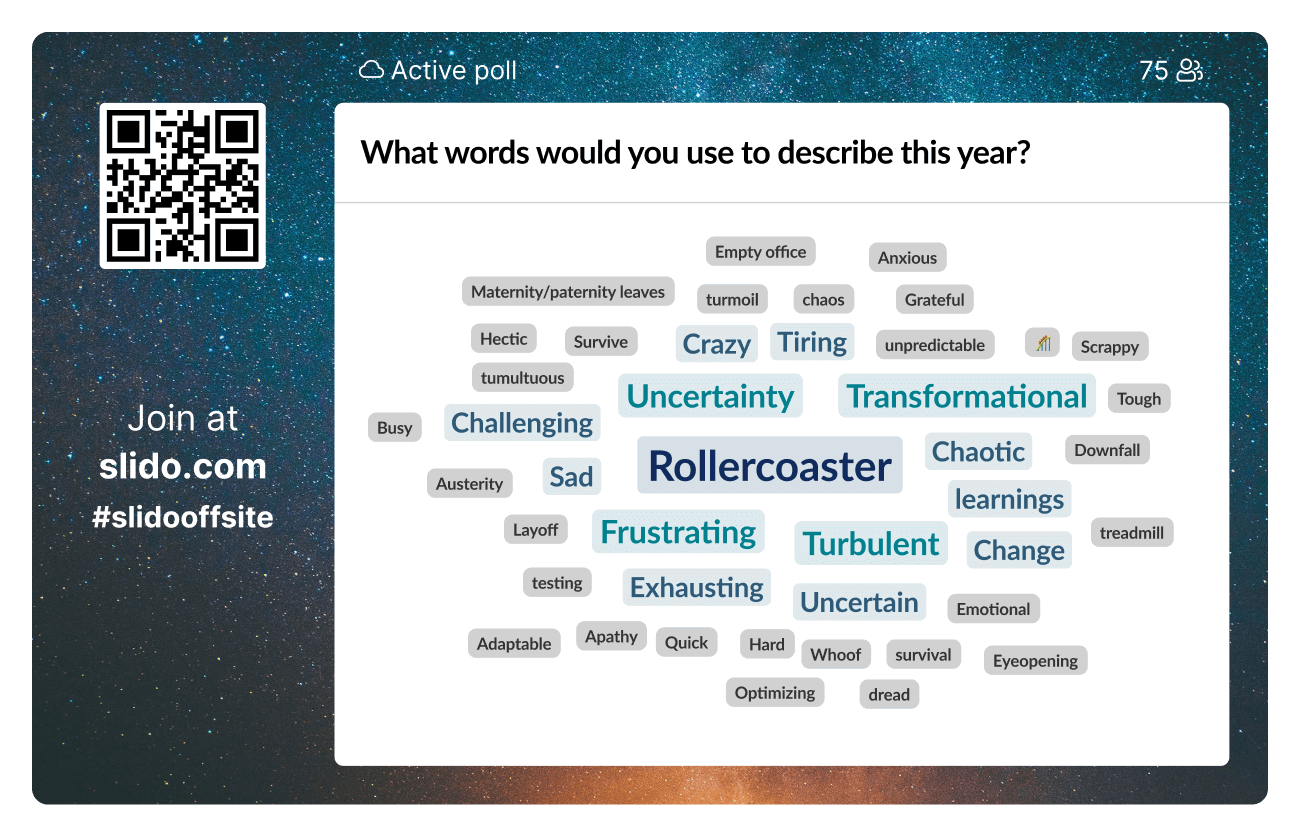
As a facilitator, I was calling out the words as they were coming through and adding personal commentary as a leader, to show empathy and acknowledgment.
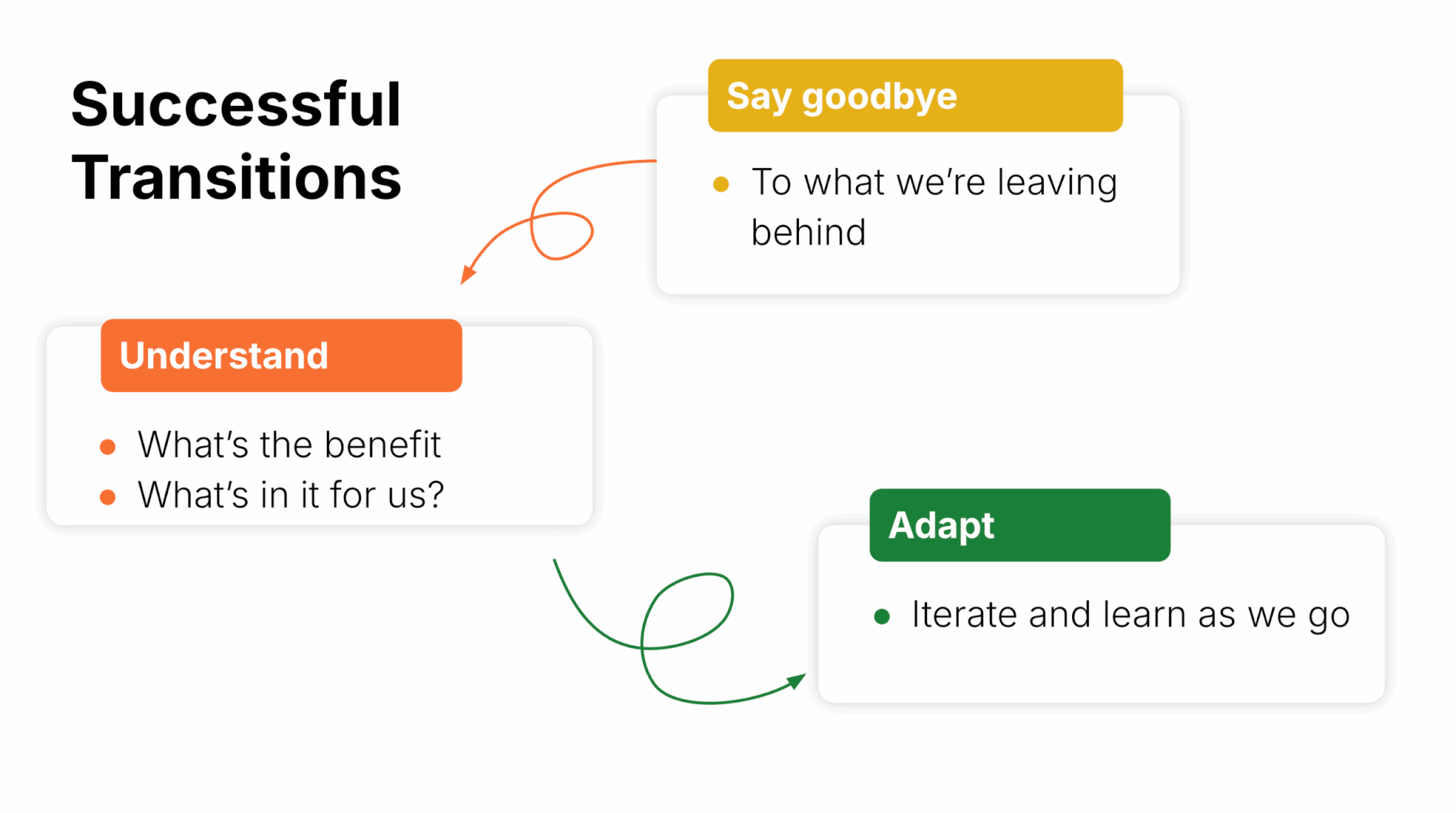
From here we then recapped all of the changes that we’ve experienced and introduced the key concepts from ‘Managing Transitions’, so they knew what to expect from the rest of the session.
These concepts include understanding that transitions begin with an ending, navigating a period of uncertainty and adjustment, and embracing a new beginning. The book also emphasizes the importance of acknowledging feelings, communicating clearly and providing support throughout each stage of change.
I then introduced each of the panel members and asked them where they feel they are on our latest transition, highlighting their differences for the audience.
Acknowledging what we’ve lost
It’s common to highlight the opportunities that come with change, however, every transition also comes with loss because you are saying goodbye to something.
That loss will be different in every situation and often personal to each individual. It can also be something different to what’s expected. For example, if you do a very small layoff for the first time, you may experience an overreaction from the team because they’ve lost the sense of safety they had in the past.
Acknowledging what’s been lost is something which is often skipped over, which can lead to decreases in engagement, morale and even failure to make the change a reality. This is especially hard when what you need to say goodbye to is something that you’re attached to or don’t want to give up.
After introducing the concept, we launched a simple word cloud poll: What do you feel you’ve lost at work over the past 12 months?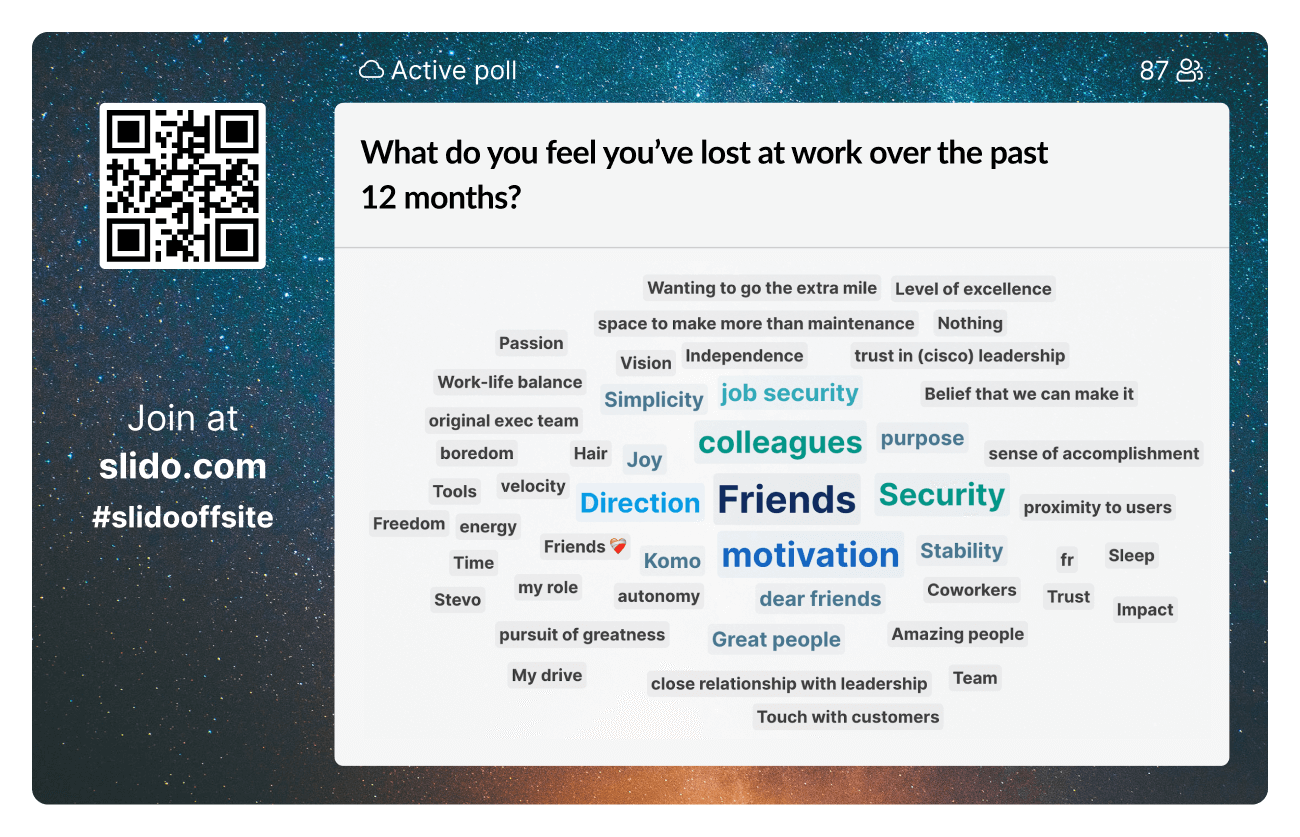
This was always going to be the toughest question as it requires the most vulnerability in the session, therefore to lead my example, as the votes were coming in, I spoke openly about what I felt like I’d lost at work.
This was important because hearing senior leaders speak openly and showing vulnerability can build psychological safety for the rest of the team. I then addressed the biggest elephants in the room by talking about how the changes we’ve experienced have affected my motivation and my mental health.
From there, it was about addressing what had been submitted in the word cloud. I started by calling out the biggest words (the bigger the word, the more people submitted it), which naturally followed on from my sharing.
I tried to weave in the panel here, calling them to share their stories and experience. In this way, we were able to comment on about 80% of what was submitted by the audience, padding out the context and addressing the sentiment behind the one-word answers.
Before closing out the section, I asked the audience if anyone wanted to share or had anything to add that we hadn’t captured well.
By acknowledging these areas of loss and talking about what we can do to ease the pain of them, this enabled us to better embrace the upsides of the changes we’re experiencing.
Understanding the opportunities
We didn’t want this session to feel depressing and so the next section revolved around another word cloud poll. This time, I asked: What opportunities are there for you personally / for the business?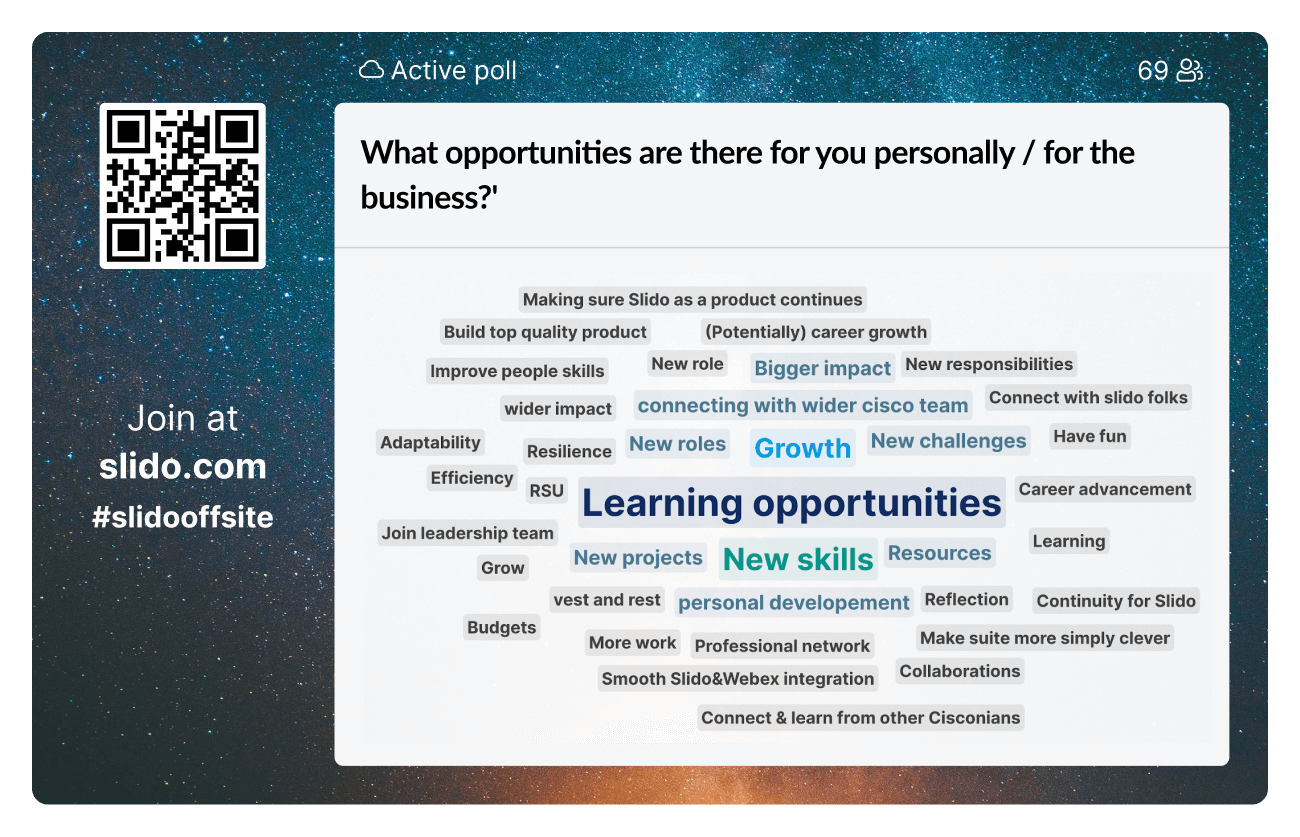
We ran the section in exactly the same way as the previous section. Acknowledging the submissions from the audience and connecting them to stories from the panel.
However, this is where the panel really came into their own. As the panel are all in senior roles with more exposure than the average team member, they were able to highlight perspectives and opportunities which didn’t come up from the audience. This helped us to broaden our horizons and grow in context as a whole team.
Embracing the future
For the final segment of audience participation, we asked an open text poll: What are you taking forward with you?
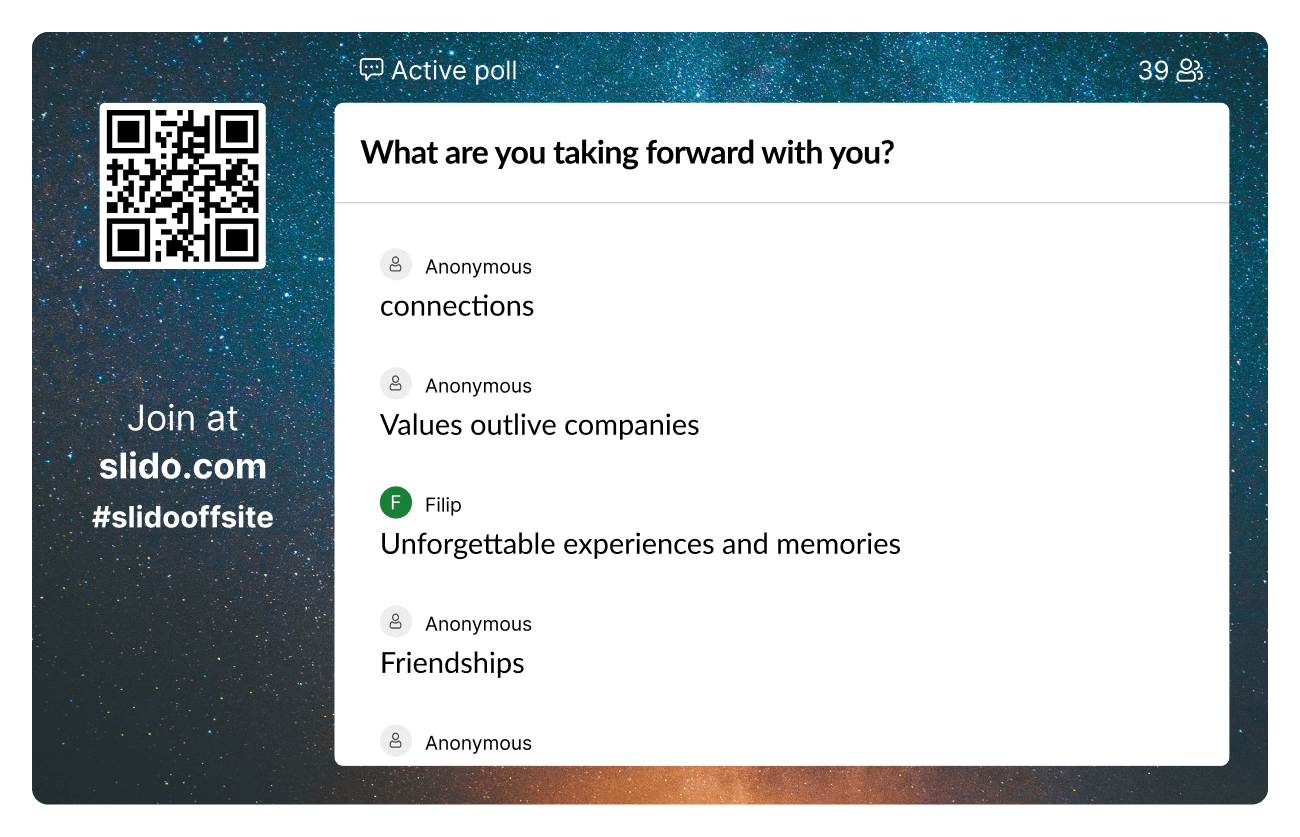
Because just as there are things that we need to say goodbye to and leave in the past, there are also learnings and elements of our culture which will continue to serve us well.
We chose to do this as an open text poll to capture more of the nuance from the audience. And I started the facilitation for this section differently by asking each of the panel members to share what they’ve learnt over the last year and what they are taking forward with them.
While the panel members spoke, I was checking the audience responses and when each member finished, I read out those which were on a similar theme.
It turned into a very engaging discussion with the panel members building on the contributions of others both on the panel and in the audience.
Q&A
As a final opportunity to include the audience and hear their voice, we closed out the interactive part of the session by taking audience questions.
We collected these through Slido, starting with the most upvoted questions and putting them to the panel as well as pulling in Slido’s General Manager to answer when more appropriate.
This was a key part of the session as we were able to address elements of the transition that hadn’t come up with the polls.
There was also a lot of vulnerability and honesty in the audience’s questions which gave us as leaders the chance to understand, acknowledge and build trust with the team.

Closing: Moving on with our transition
Processing transitions is different for everyone. For some it will be faster and for others it will be incredibly difficult. In order to close this session, I thanked everyone for their vulnerability and honesty.
I then shared some uplifting but realistic closing thoughts. The only thing that we can guarantee is that there will be a lot of change.
I highlighted for the team the things that matter: what we should focus on that’s within our control and advice around how we can do our best by being there for one another and for our customers, taking responsibility and being human.
From there we asked the team for their feedback to understand how useful they found the session.
As expected, it was of two extremes. People either really liked it or they weren’t very keen. We were happy with this outcome as we knew that not everyone needed it.
However, as a leadership team we learnt a lot from this session through all of the inputs we collected through Slido. We would definitely repeat it again in the future if appropriate on an individual team level.
Hopefully the polls and session format can be some inspiration for you the next time you’re facing a tough transition with your team.