

January meetings can either be a soft landing into business as usual or the moment you set the tone for a focused and productive year.
The difference usually isn’t a bigger slide deck or longer meetings, it’s running intentional sessions to help your team reflect on what to take from 2025, align on what matters in 2026 and kick off the year with clarity and energy.
Here are some practical tips for meeting activities you can run at the start of the year to kick things off on a high note; all simple to facilitate, easy to adapt for your work environment and designed to actually move the needle. Whether you lead a small team or a larger, remote or hybrid one, we’re sure you get inspired.
1/ Review 2025 in a retrospective that leads to positive action (not just venting)
Retrospectives give your team a structured way to look back at what worked, what didn’t and what you want to improve going forward. The biggest win is that you’re not guessing what needs fixing; you’re uncovering patterns as a team and turning them into decisions.
To keep it energizing (and inclusive), activate everyone from the start. A quick pulse check like “How did 2025 feel for you?” works well in a rating poll or a one-word check-in.
Then move into something like Stop–Start–Continue. This is a very simple and effective group activity where you manage to get answers to and discuss:
- What should we stop doing?
- What should we start doing?
- What should we continue doing?
If your team is larger, split into breakout groups of 5–6, give people a fixed timeframe and ask each group to write down their input and submit it into Slido (e.g. open text poll). Alternatively, you may ask your colleagues to prepare their answers before the meeting.
Then bring everyone back and review entries together, asking people to elaborate and discuss how you can translate the insights into concrete next steps. Don’t let your retro die at the finish line: Choose a small number of changes you’ll actually implement and propose the next action. You may also vote on the proposed changes to establish priorities by using a multiple choice poll or ranking poll.
Last but not least, remember that retros can easily spiral into an everything-is-broken type of mindset so keep an eye on balancing honesty with positive reinforcement. Intentionally weave in an activity where you celebrate wins and make space for appreciation.
Here are some poll questions to ask:
- What was our biggest success as a team in 2025?
- Who from the team would you like to thank and why?
- What are you most excited about in 2026?
Read also: How To Run a Great Retrospective With Your Remote Team
2/ Prioritize, prioritize, prioritize
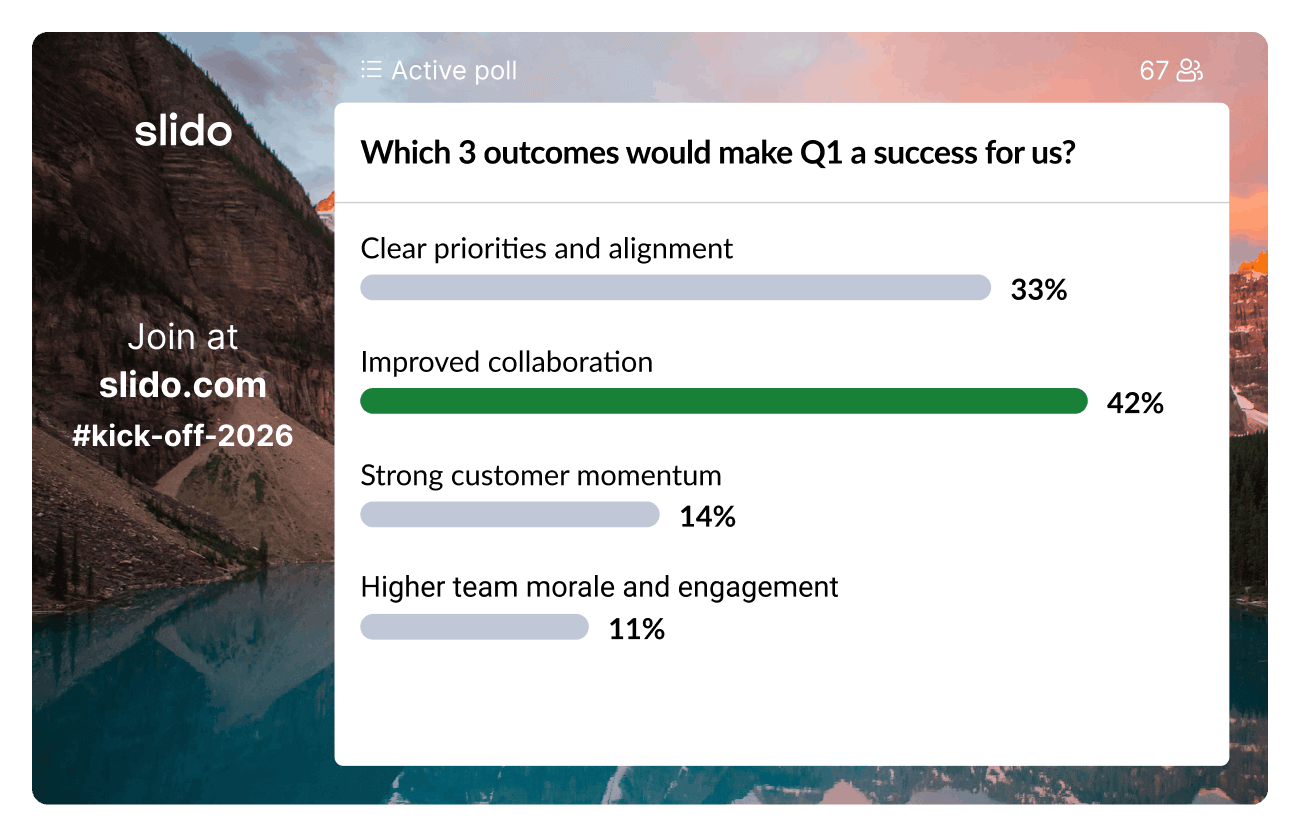 Once you’ve looked back, it’s time to look forward. Setting clear priorities is one of the most important things to do when kicking off a new year because it gives people direction, reduces confusion and helps set realistic expectations.
Start by defining team objectives before you debate tasks. Using OKRs (objectives + key results) is one practical way to make goals and success criteria visible to everyone.
Then get realistic. One of the easiest ways to derail a year is overcommitting in January. Use what you learned in the retro to set realistic expectations and deadlines. Retrospectives help here because they surface the roadblocks you hit last year, so you can plan with eyes open this year.
You can also make prioritization collaborative. Crowdsource priorities from your team first (open text works well here) to see what feels most urgent or impactful. From there, use a ranking poll to get a clear top-down view of what should come first.
Here are some poll questions you can ask:
- Which 3 outcomes would make Q1 a success for us?
- What do you think are our top 3 priorities this year?
- What should we focus on this year?
- Rank these initiatives by impact on our team objective.
If your team needs a simple framework for day-to-day and project-level choices, a basic urgency/importance (Eisenhower-style) matrix can help you sort what to do first, what to schedule next, what to delegate, and what not to do at all.
A brief checklist for team goals and task prioritization:
- Define clear objectives (start with “why”). If objectives aren’t clear, prioritization becomes guesswork.
- Align on what your team is trying to achieve in 2026 (or at least in Q1) before you debate tasks.
- Tap into collective intelligence. Ask people what they believe is most important for the next quarter/season and discuss.
- Rank priorities together. Use a Slido ranking poll to uncover what the team believes is most urgent or important.
- Consider a “Not-to-do list.” A clear not-to-do list gives people permission to say no to work that distracts from the objective.
Read also: How to Prioritize Tasks Effectively When You’re Managing a Team
3/ Kick off 2026 like you would kick off a project
 If you want 2026 to feel aligned, treat the year (or at least Q1) like a project worth kicking off properly.
Every project kick off meeting should have clearly defined the Whats, Whys, Whos and Hows. In plain language: what you’re doing (scope, deliverables, what success looks like), why it matters (purpose, how it fits strategy), who’s involved (roles and responsibilities) and how you’ll work together (cadence, resources, ways of working).
Make the year’s kick off meeting interactive at the moments where alignment matters most. Crowdsource risks early by asking poll questions like: “What potential risks may we encounter?” Give people a minute to think, then collect inputs and review them together. The goal isn’t to predict everything; it’s to remove surprises and agree on mitigation before you’re in the middle of delivery.
When discussions start looping (which they often do at the start of a new initiative), move the group forward democratically. A quick multiple choice or ranking poll can narrow options and prevent 20 minutes of debate that ends with “Let’s circle back.”
A content-heavy kick-off naturally creates questions so leave space for Slido Q&A as well. Your goal is for everyone to leave aligned and ready. Then send out minutes so decisions don’t get lost in post-meeting fog.
A brief checklist to kick off your successful project (year):
- Define what’s in scope vs. out of scope. Ask your team to help define boundaries so you don’t discover mismatched expectations in March.
- Be aware of potential risks and discuss their mitigation openly.
- Create space for Q&A so everyone leaves aligned and with clarity.
Read also: 7 Interactive Tips for Running a Better Project Kick-off Meeting
4/ Make 2026 a year of inclusive team discussions (where you hear also from the quieter team members)
If you’ve ever asked “So… what do you guys think?” and got silence, you’re not alone. Yes, the most vocal members of your team may ask questions or voice their opinions but the truth is, many people need a nudge to engage, especially early in the year when priorities feel fuzzy. Sometimes, you just need to give them a springboard.
 Here are five discussion tactics you can run in any meeting:
1. Warm-up with a poll question people may want to answer
Skip “How was your weekend?” and start with something more interesting to get the room talking.
- What should we do differently in 2026 to make work more sustainable? (great segue into priorities)
- What is the one goal (personal or professional) you want to achieve in 2026?
- If you didn’t do your current job, what career would you choose?
2. Do a quick pulse check before you debate
Rating questions get the room’s “temperature” and give you a natural entry point into discussion: ask people to elaborate on why they rated the way they did, especially if you see clear outliers.
- 1–10: How confident are you about our Q1 plan?
- 1–10: How clear are our 2026 priorities?
3. Brainwrite before you discuss
Give people time to think and write down opinions first, then review responses and discuss the key themes. This keeps debates structured and inclusive – some people just need time to process their thoughts.
4. Move discussion toward a decision
If a conversation is going in circles and you can’t seem to be getting to a decision, narrow the options with the help of a ranking poll or multiple choice poll.
5. Crowdsource people’s questions anonymously through Slido Q&A
Some people aren’t comfortable asking questions openly in front of others. To make sure none of your teammates’ concerns get omitted, give them the option to ask via Slido.
5/ Brainstorm for 2026 ideas without groupthink (and with a clear outcome)
Brainstorming is powerful in January because people are naturally reflective and forward-looking. But it only works if you separate idea generation from evaluation. And of course, when you do not let only the loudest voices dominate, but give everyone an equal voice.
A simple flow that works well: collect ideas (live or async), cluster similar submissions, discuss the top themes, then decide what happens next. If you need a decision, move from “discussion mode” into “choice mode” with a ranking poll or multiple choice poll, otherwise the brainstorm becomes an inspiring list that nobody owns.
Use a Slido open text poll, where people can submit their individual ideas or let them brainstorm in groups.
Five facilitation tips for making brainstorming more inclusive and productive:
- Give everyone an equal chance to contribute (don’t rely only on speaking up).
- Let people think up ideas in advance (brainstorming shouldn’t start at the meeting).
- Include people who can’t attend live by collecting input beforehand.
- Allow anonymous submissions when topics are sensitive or political.
- Separate idea generation from discussion so you don’t kill new ideas too early.
Read also: 5 Tips for Designing an Inclusive (Remote-Friendly) Brainstorming Session
6/ Add a 5-minute team-building moment to remind people it’s not all just about work
Team-building doesn’t have to be an offsite. A tiny activity at the start of a January meeting can help rebuild connection, especially if your team is hybrid or has new members.
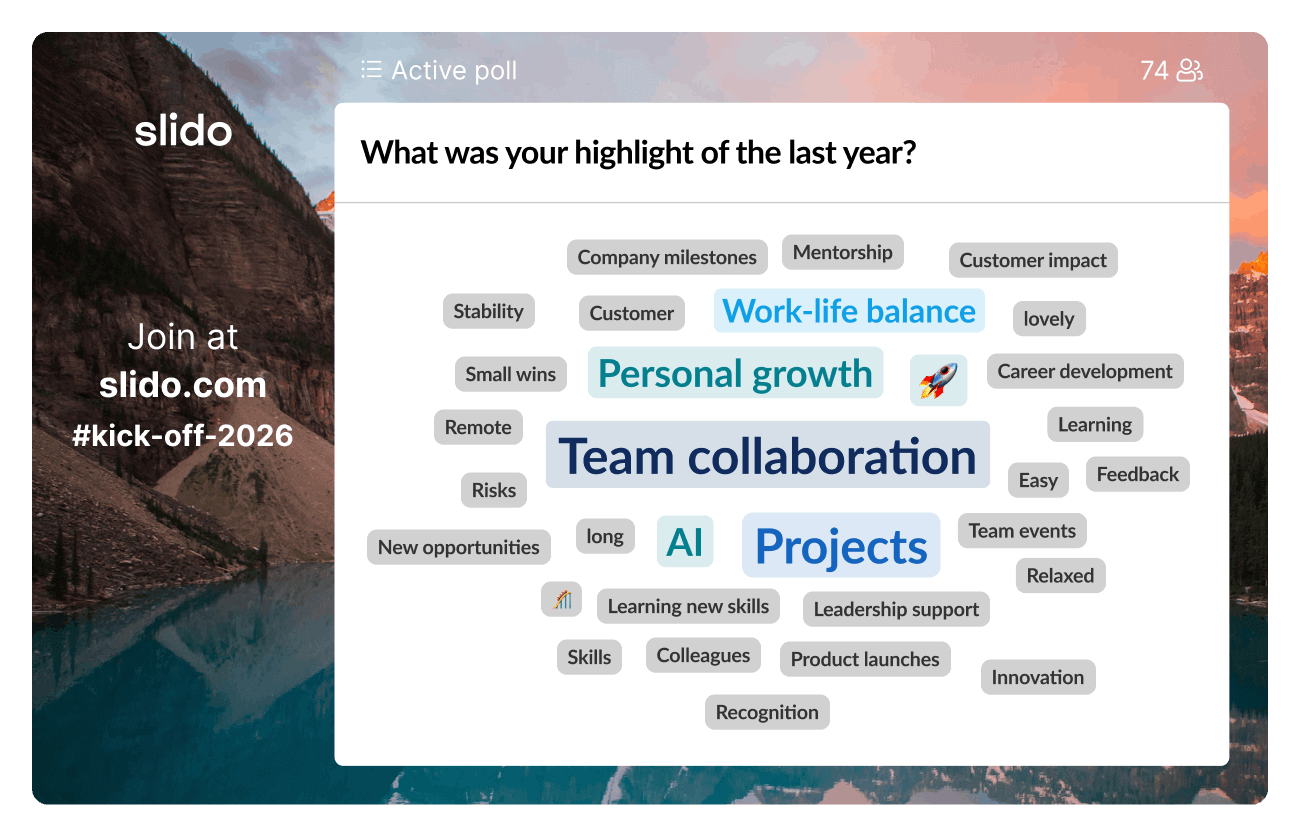
Here are a few fast options:
- Would you rather…? (quick debate starter, steal some ideas from here)
- Quiz question of the week (energizing, easy tradition, find inspiration here)
- Word cloud of highlights (“What was your highlight of the last year?”)
- Caption this (creative, surprisingly bonding)
- Icebreaker questions in pairs (great for hybrid via breakout rooms, ideas here)
The trick is to make it feel not random – you may want to tie it lightly to the season or occasion. For example, in January we recommend asking something last-year-recap related or finding out something that people are looking forward to in the new year.
Read also: 8 Super Engaging 5-Minute Team Building Activities for Your Meetings

A simple way to put this into practice
If you’re staring at your calendar and thinking “I don’t have time for all of this,” good news, you don’t need all of it. Pick two anchors. For example,
- A 2025 retrospective that ends with 1–3 concrete changes you’ll implement.
- A 2026 priorities + kick-off meeting that clarifies the What/Why/Who/How and produces a short not-to-do list.
You can fit all of these activities into one longer meeting or just pick one or two activities that sound like they might be relevant and helpful for your particular team and goals.
Wishing you a great jump into 2026!