

If you’re a project manager or have recently taken on a project leadership role, one of your first priorities should be getting your project off to a strong start. And that begins with a successful kick-off meeting.
A good project kick-off isn’t just about presenting a project plan. It’s about bringing everyone on board, setting clear expectations, identifying potential roadblocks and getting your team actively involved from day one.
Get it right and your team walks away knowing exactly what they’re working towards, who’s responsible for what and what needs to happen next. It can also give your teammates a welcome boost of motivation!
In this article, we’ll show you how to plan and run a great project kick-off meeting, from building your agenda to making the session interactive and engaging.
- What is a project kick-off meeting and why should you run one?
- How to build an agenda for a project kick-off meeting
- 5 interaction tips for running more productive project kick-offs

What is a project kick-off meeting and why should you run one?
A project kick-off meeting is the first meeting that brings together the project team (and sometimes the client) before they embark on a project. It’s typically led by the project manager, who introduces everyone involved to the project’s goals and overall vision.
The purpose is simple: to get everyone on the same page before the actual work begins. During a kick-off meeting, you discuss the project’s scope, timeline and key deliverables. After all, you wouldn’t jump on a train without knowing where it’s headed, right?
Run well, a project kick-off meeting helps you:
- Set clear expectations
- Align everyone on the project’s goals and objectives
- Get to know the team and clarify everyone’s roles and responsibilities
- Establish a project timeline
- Define the project’s scope and key deliverables
- Identify potential risks and roadblocks
- Build team morale and motivation
- Agree on the next steps
- Address any outstanding questions and concerns
A kick-off shouldn’t be a one-way presentation where the project manager talks for an hour while everyone else takes notes. The more opportunities your teammates have to contribute, the more useful input you’ll collect before the project even begins.
How to build an agenda for a project kick-off meeting
There’s no universal agenda that works for every project. A marketing campaign, a product launch and a major website redesign will have different requirements, stakeholders and levels of complexity.
However, every good project kick-off should answer five fundamental questions: what, why, who, how and when.
- The “what”: Define the project and its scope
Explain what you’re setting out to achieve. Introduce the project’s objectives, main outputs and expected results.
Be specific about what’s in scope and what’s out of scope. If you’re kicking off a website redesign, for example, are you also rewriting all the website content? Does the project include SEO migration? Who’s responsible for the illustrations?
Clarifying these boundaries early can prevent unnecessary work and misunderstandings later.
- The “why”: Explain the purpose behind the project
Don’t assume everyone knows why the project matters. Give your team the bigger picture: What problem are you trying to solve? How does this project contribute to the company’s objectives? What will change when it’s successfully delivered?
For example, instead of simply announcing that you’re redesigning the company website, explain that the current site isn’t converting enough visitors into customers and that your goal is to improve conversion rates.
A clearly communicated purpose gives people context for their work and helps them make better decisions throughout the project.
- The “who”: Introduce the team and clarify responsibilities
Who’s involved? Who owns which deliverables? And who has the final say when decisions need to be made?
Introduce the team, including any external stakeholders or clients. Clarify the responsibilities of individual team members, the project manager and the people responsible for approvals.
If some team members haven’t worked together before, make room for brief introductions. Knowing who to turn to for what can make collaboration much easier.
- The “how”: Agree on ways of working
This is where you move from discussing what needs to happen to how you’re going to make it happen.
Cover the tools you’ll use, communication channels, meeting frequency, reporting, approval processes and any resources the team needs. Establish how you’ll handle feedback and make decisions when opinions differ.
Don’t forget to discuss potential risks and dependencies. What could prevent your team from delivering on time? Are you waiting for input from another department? Does a key deliverable depend on an external supplier?
These are exactly the kinds of questions worth discussing with the whole team.
- The “when”: Walk everyone through the project timeline
Present the overall timeline, including the final deadline, major milestones, important dependencies and expected delivery dates. Make sure everyone understands which tasks need to happen first and where their work fits into the bigger picture.
Most importantly, don’t just present the timeline and assume everyone’s happy with it. Ask your team whether they think it’s realistic and give them space to raise concerns.
For example, your 90-minute kick-off meeting agenda could look like this:
- Welcome and introductions (5 minutes): Introduce participants, run an icebreaker poll and explain the meeting objectives.
- Project overview and purpose (10 minutes): Present the vision, objectives and expected outcomes.
- Roles and responsibilities (10 minutes): Introduce the team, decision-makers and stakeholders.
- Scope and deliverables (20 minutes): Clarify what’s included, what’s excluded and what success looks like. Brainstorm and discuss.
- Timeline, risks and dependencies (20 minutes): Review milestones, crowdsource potential roadblocks and discuss.
- Priorities and ways of working (10 minutes): Agree on priorities, communication and decision-making.
- Q&A and alignment check (10 minutes): Address questions and check understanding.
- Next steps (5 minutes): Confirm actions, owners and deadlines.
💡 Tip
Share the agenda and project brief with your teammates ahead of the meeting by email, through your internal communication channels or attach them directly to the meeting invite.
You can also share a Slido link to collect your team’s questions or ideas before the meeting. This gives people time to think and helps you identify topics that may need more attention.
5 interaction tips for running more productive project kick-offs
You’ve prepared your agenda, invited the right people and put together your project presentation. Now comes the important part: preparing to run the meeting. How do you make sure it’s actually productive?
Create the right conditions for everyone to contribute and encourage meaningful discussion throughout the meeting. Leverage your team’s collective knowledge to identify risks, challenge assumptions, make decisions and get the project off to a strong start.
Here are a few simple interaction techniques and facilitation tips that will help you get there.
1. Start strong: Get everyone involved from the beginning
One of the important things about starting a new project is getting everyone excited about it. Rather than jumping straight into a 30-slide presentation, start with a short, meaningful interaction to get people involved from the get-go.
Depending on your team, this could be a quick get-to-know-you activity (if some people haven’t met yet) or a short poll that introduces the project. Ideally, choose something that gets people thinking and participating while giving you useful insight into how they’re feeling about the work ahead.
For example, run a quick Slido poll to break the ice and make it easier for everyone to contribute, whether they’re shy or vocal, joining in person or online.
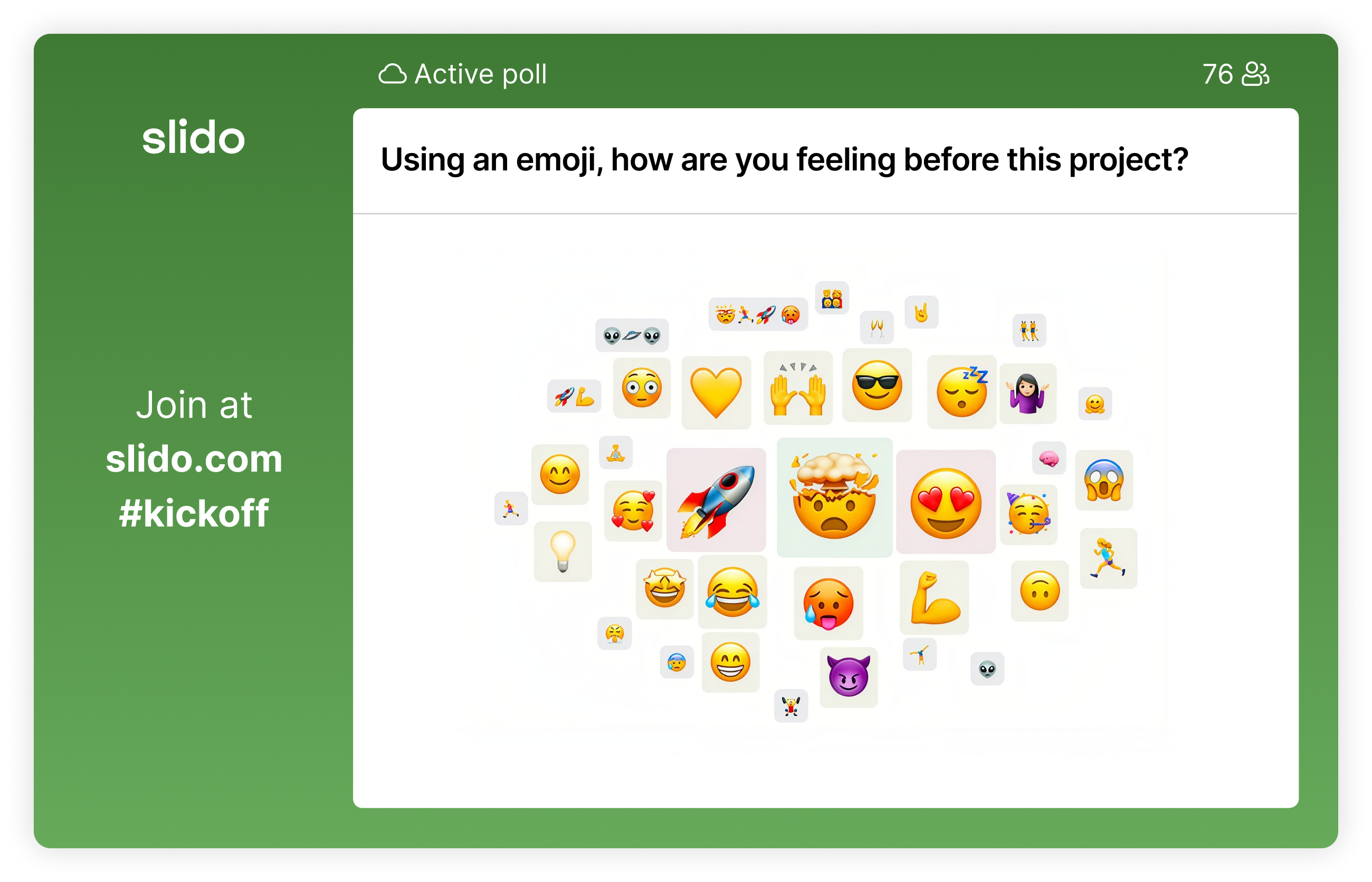
Here are some poll questions to try:
- On a scale of 1–10, how excited are you about the project? (Rating)
- Using an emoji, how do you feel about this project? (Word cloud)
- What’s one word that describes how you feel about this project? (Word cloud)
- Describe our team using an emoji. (Word cloud)
- What are you most looking forward to in this project? (Open text)
- Which area of the project are you most excited to work on? (Multiple-choice poll)
- How confident are you about the project ahead? (Rating poll)
Or try our AI-Generated polls from prompt to give you suggestions based on what you are trying to achieve.
Once everyone’s responded, show the results on screen and use them to start a conversation. If some participants seem unsure or uneasy about the project, for instance, ask what’s behind their concerns. It’s an opportunity to understand the room and uncover issues you might otherwise discover much later.
If you’re kicking off a project with a completely new team, you can also include a brief introduction round. Ask everyone to share their role, what they’ll be responsible for and what they’re hoping to contribute.
💡 Tip
If you’re presenting a slide deck, add Slido polls and Q&A directly to your Google Slides or PowerPoint presentation using our free integrations. That way, you can run interactions without switching between tools.
2. Brainstorm with your team to define the scope and uncover potential risks
One of the most valuable things you can do during a kick-off meeting is tap into your team’s collective expertise. Your colleagues may spot gaps in the project brief, anticipate dependencies you haven’t considered or identify potential risks based on previous experience.
Risk assessment is a key part of a project kick-off. You want to uncover potential issues before they derail your plans. But simply asking, “Does anyone see any problems with this plan?” rarely gets you the input you need.
Instead, dedicate part of the meeting to structured brainstorming. This is where Slido Ideas comes in handy. It helps you bring together ideas and organize responses into themes to make the discussion easier to facilitate.
Collecting input in writing gives everyone an opportunity to contribute before the discussion starts. Remote participants can take part just as easily as people in the room and you’re less likely to have everyone follow the first idea someone puts forward.
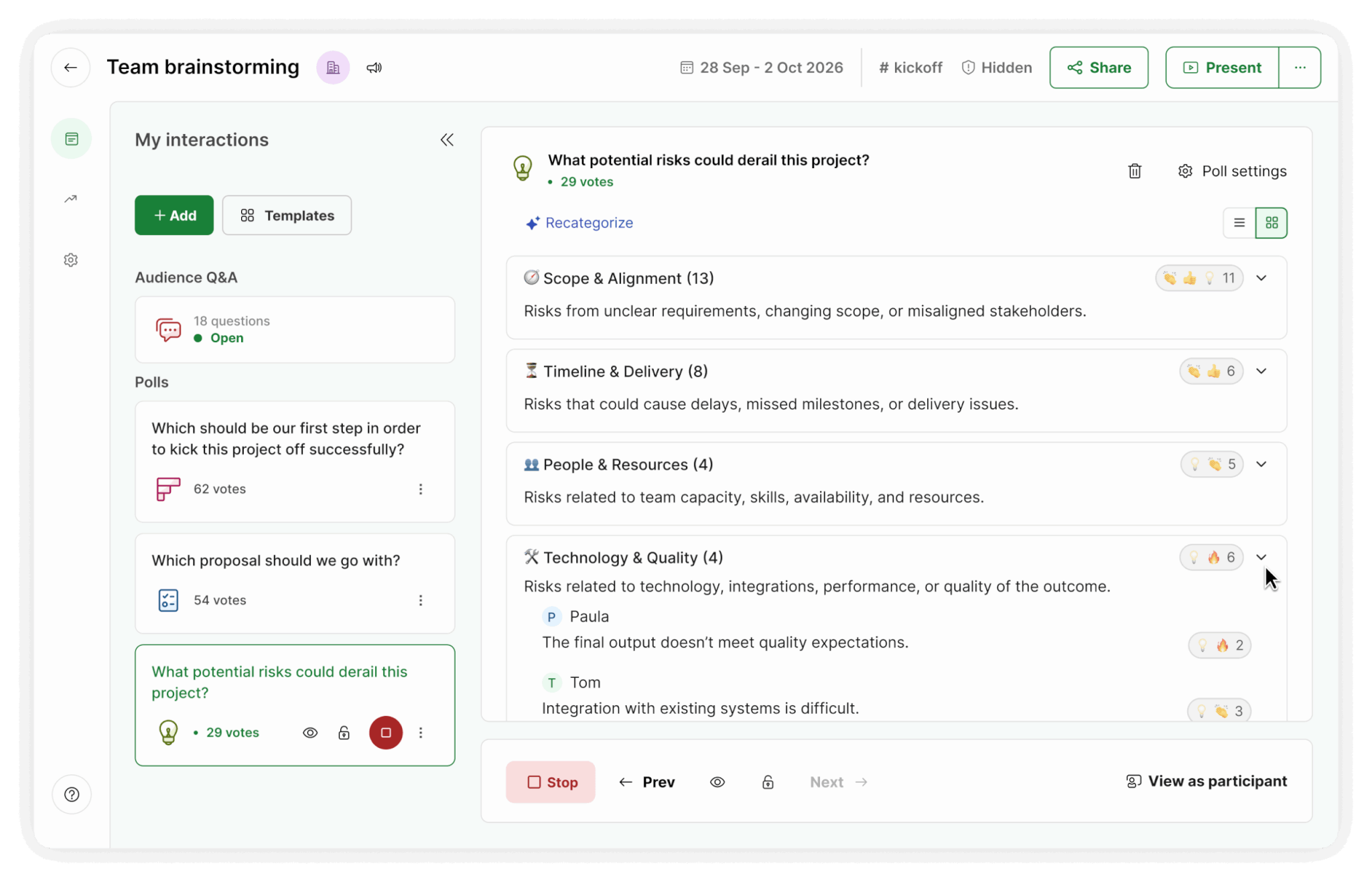
Here’s an example of a brainstorming flow you can try:
Step 1: Collect input
Start with one focused question rather than trying to brainstorm every aspect of the project at once.
For example: “What potential risks could derail this project?”
Give everyone three minutes to think and submit their ideas independently in Slido. Allow anonymous submissions if you think that would encourage more candid input.
Step 2: Prioritize
Ask teammates to read each other’s ideas and react to those that resonate with them. The submissions that receive the most support become natural starting points for discussion.
Step 3: Organize
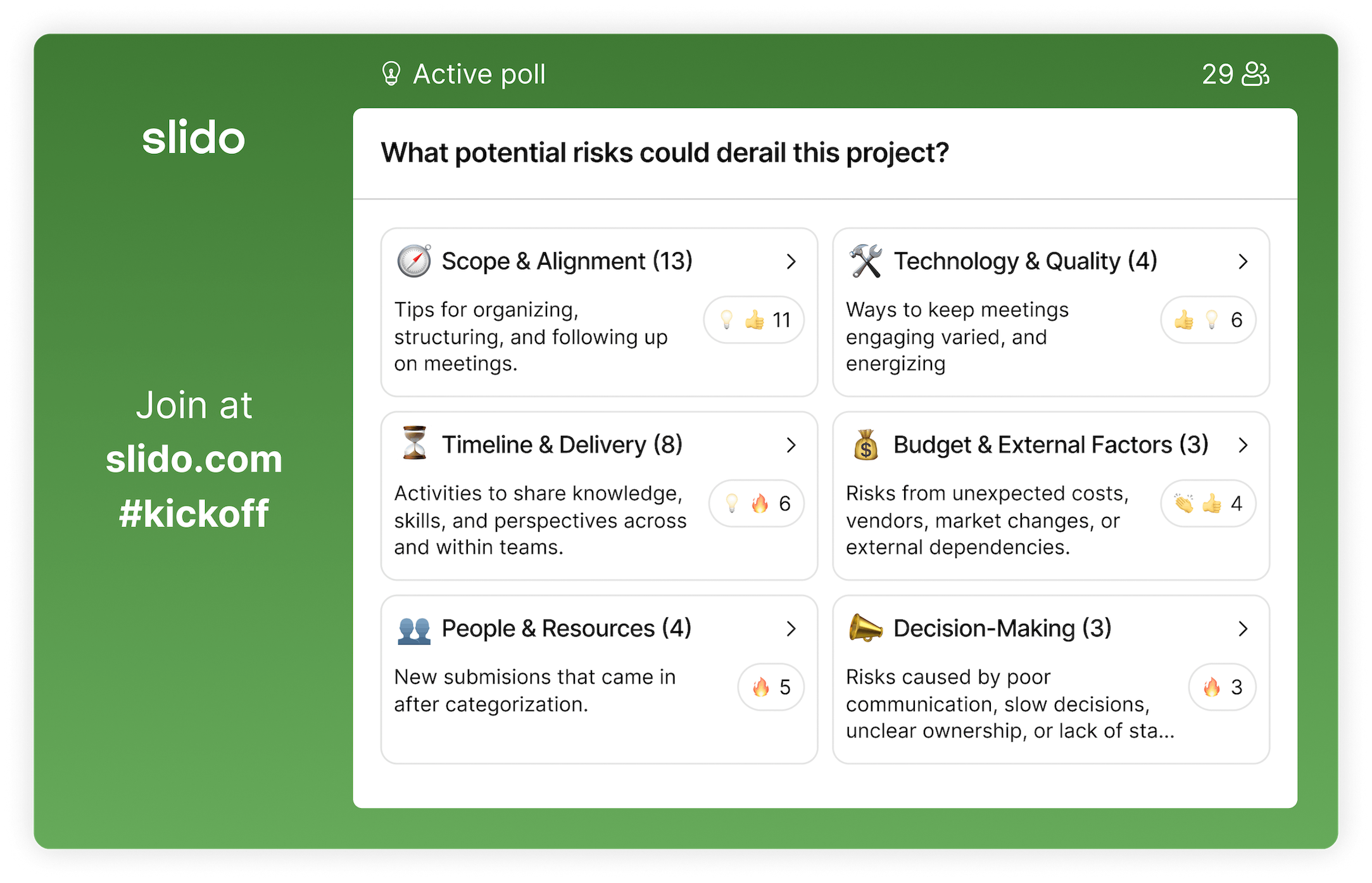
Use Slido Ideas’ AI-powered categorization to group similar submissions into common themes. Instead of spending ten minutes manually sorting feedback, you can move straight into discussing the issues.
Step 4: Discuss
Look at the main categories, assess which risks are most likely to occur and which would have the greatest impact, then agree on ways to prevent or mitigate them. Assign owners to the actions you identify.
You can repeat this activity for other important kick-off questions, such as “What’s missing from our project plan?”, “What should be explicitly out of scope?” or “What resources do we need to deliver successfully?”
3. Prioritize together and agree on the next steps
While some decisions may have already been made, you’ll probably need to agree on other priorities and tasks as you move through the agenda. With lots of ideas on the table and plenty of work ahead, it can be difficult to get everyone aligned on what to do next.
A structured voting goes a long way here. It can save you from spending too much time debating options without reaching a conclusion.
With Slido Ideas, you can ask a focused question, gather suggestions and use reactions to see which ideas resonate with the team. The AI-powered categorization makes the input easier to navigate. Use these insights to discuss and prioritize the most important suggestions.
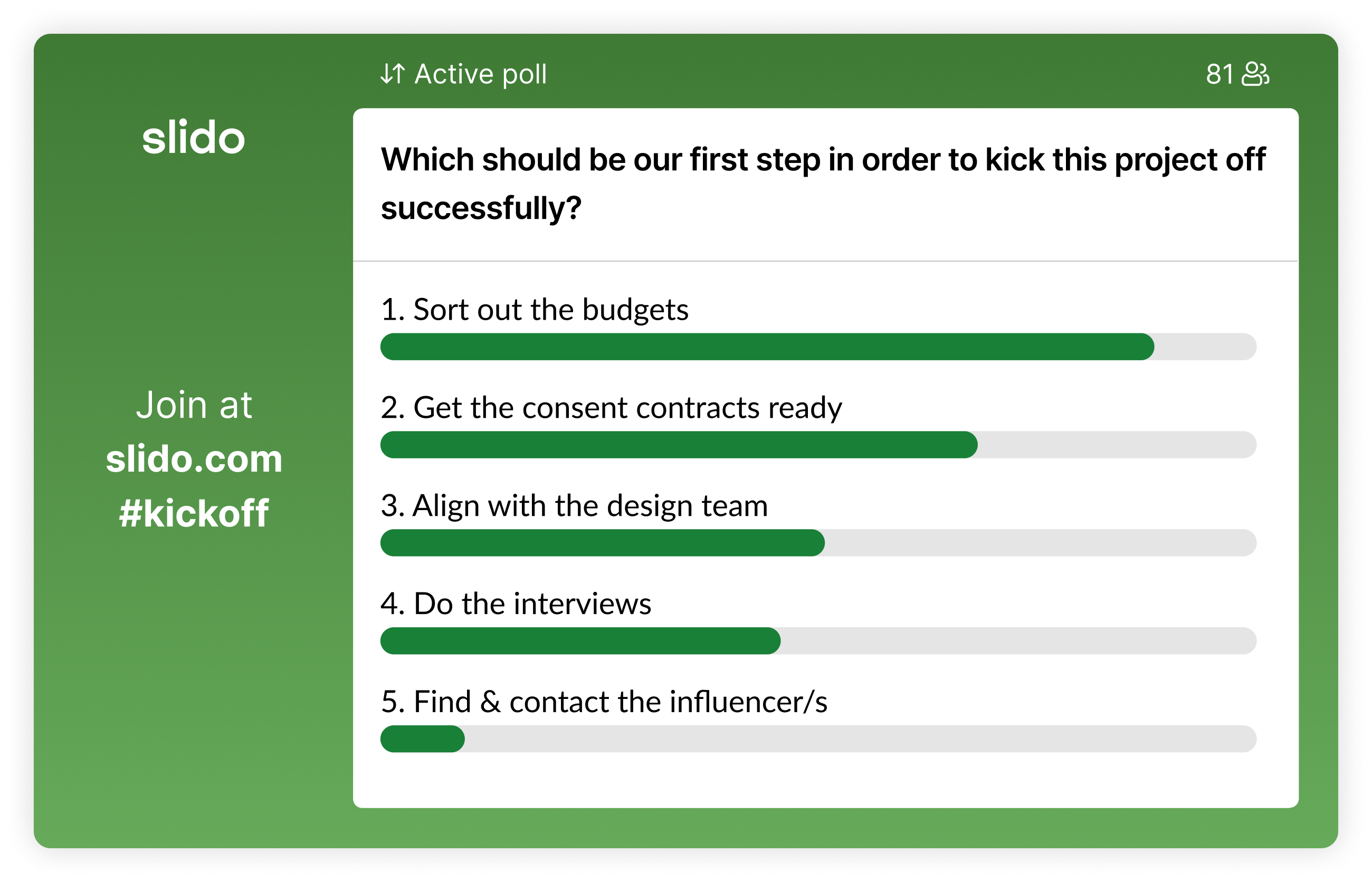
 You can also use polls to give everyone a say before making a decision. Once you’ve narrowed down your options, run a ranking poll to help your team prioritize them.
For example:
- “Which of these challenges should we tackle first to get the project moving?” (Ranking poll)
- “Rank these project milestones in order of priority.” (Ranking poll)
- “Which three initiatives should we focus on during the first month?” (Ranking poll)
 If you’re choosing between two or three options, you can also use a multiple-choice poll. It’s handy for operational decisions, such as how frequently the team should meet for project updates or which communication channel to use.
The important thing is to distinguish between collecting opinions and making decisions. Voting helps you understand the group’s preferences, but you’ll still need to consider resources, dependencies and other project constraints before finalizing your priorities.
Before moving on, turn those priorities into concrete actions. Agree on who’s responsible for each task, what needs to happen first and when you’ll review progress.
💡 Tip
Keep a shared action log visible throughout the meeting. Whenever you agree on something, record the decision, its owner and the deadline immediately. It’ll save you from trying to reconstruct the conversation afterwards. After the meeting, send a short recap covering the agreed project scope, key objectives, deliverables, timeline, responsibilities and decisions.
4. Speed up lengthy discussions to move the meeting forward
One of the biggest challenges of facilitating a kick-off meeting is keeping the discussion on track.
It’s easy to spend 10 minutes debating one aspect of the project while leaving little time for other equally important topics. Before you know it, the meeting is running over, half the agenda is untouched and you’ve made very few decisions.
As the meeting facilitator, your job is to encourage discussion while helping the team move towards a conclusion.
Start by giving each agenda item a clear objective and a time limit. Make it explicit whether you’re sharing information, collecting feedback, exploring options or making a decision. This helps your teammates understand what’s expected of them.
If a discussion starts going in circles, summarize the main points of disagreement and ask the team to identify what’s preventing them from moving forward.
For example, imagine your team is debating whether to extend the project deadline or reduce its scope. Rather than letting the discussion continue indefinitely, run a quick Slido multiple-choice poll to find out where everyone stands.
How should we address the proposed project timeline?
- Extend the deadline
- Reduce the project scope
- Bring in additional resources
- Explore another solution
The results give you a clearer picture of the team’s preferences. If one option has considerable support, explore whether it’s feasible. If the votes are evenly split, ask what information the team still needs to reach a decision.
Another useful technique is to create a parking lot for issues that don’t need to be resolved during the kick-off. If a discussion becomes too detailed or moves beyond the meeting’s objectives, record the issue, assign someone to investigate it and agree on when to revisit it.
💡 Tip
Use our AI-Generated polls from prompt by sharing key topics or the meeting goal and see what polls are suggested to move the process forward.
5. Make sure everyone leaves the meeting aligned
Your team will have plenty of questions as you walk through the project’s objectives, scope and timeline. Make room for Q&A after content-heavy sections and towards the end of the meeting. After all, the goal of a project kick-off is for everyone to leave feeling informed, aligned and ready to get started.
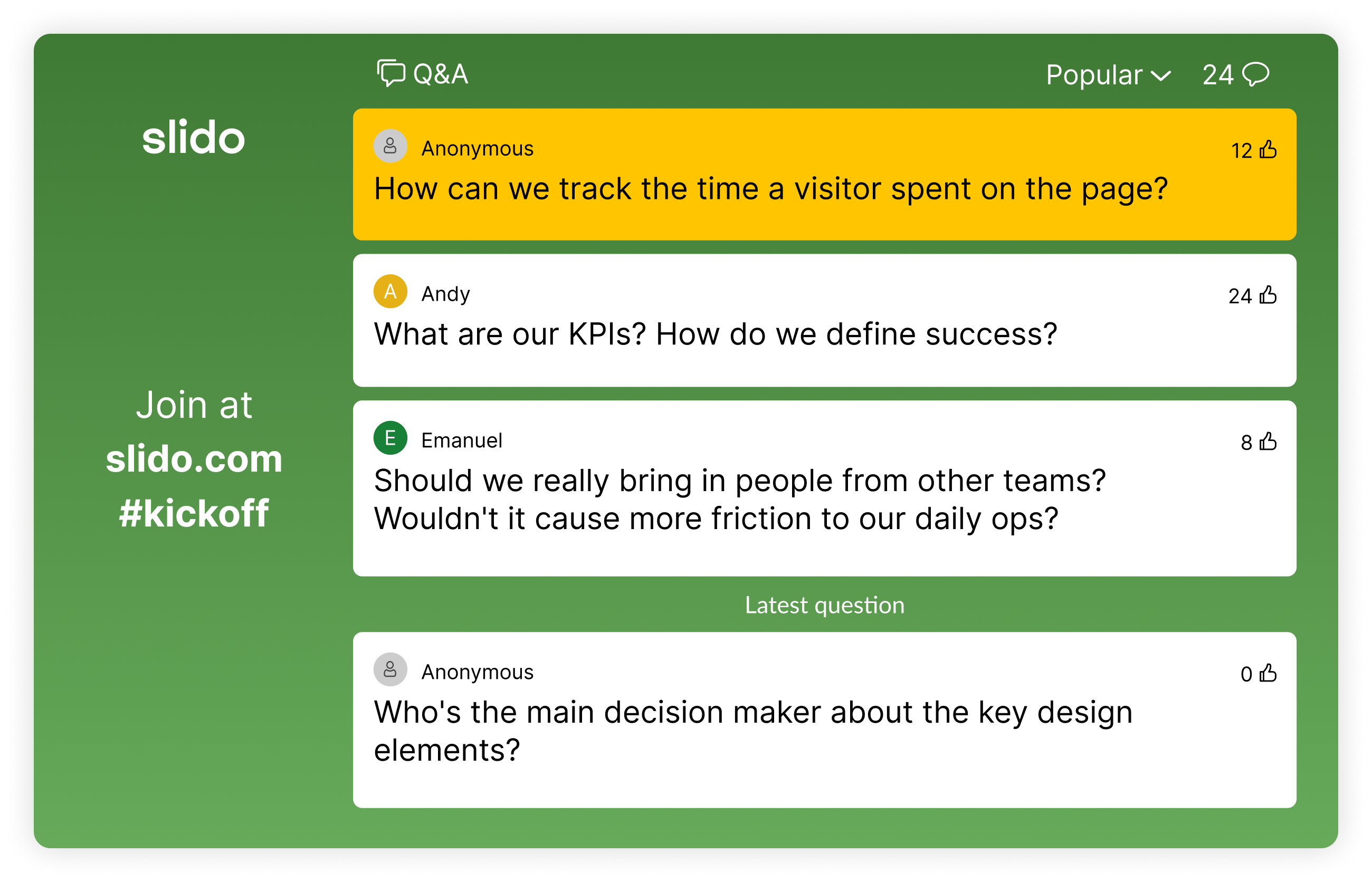
Collect your team’s questions using Slido Q&A. Participants can submit questions at any time throughout the meeting, even anonymously if they prefer. They can also upvote questions submitted by others, helping you identify which issues matter most to the group.
Encourage everyone to post questions whenever they come up. Address the most relevant ones after each major section and reserve a dedicated Q&A slot towards the end for anything outstanding. You could set aside at least ten minutes for Q&A or take questions as they come in, depending on the format of your meeting.
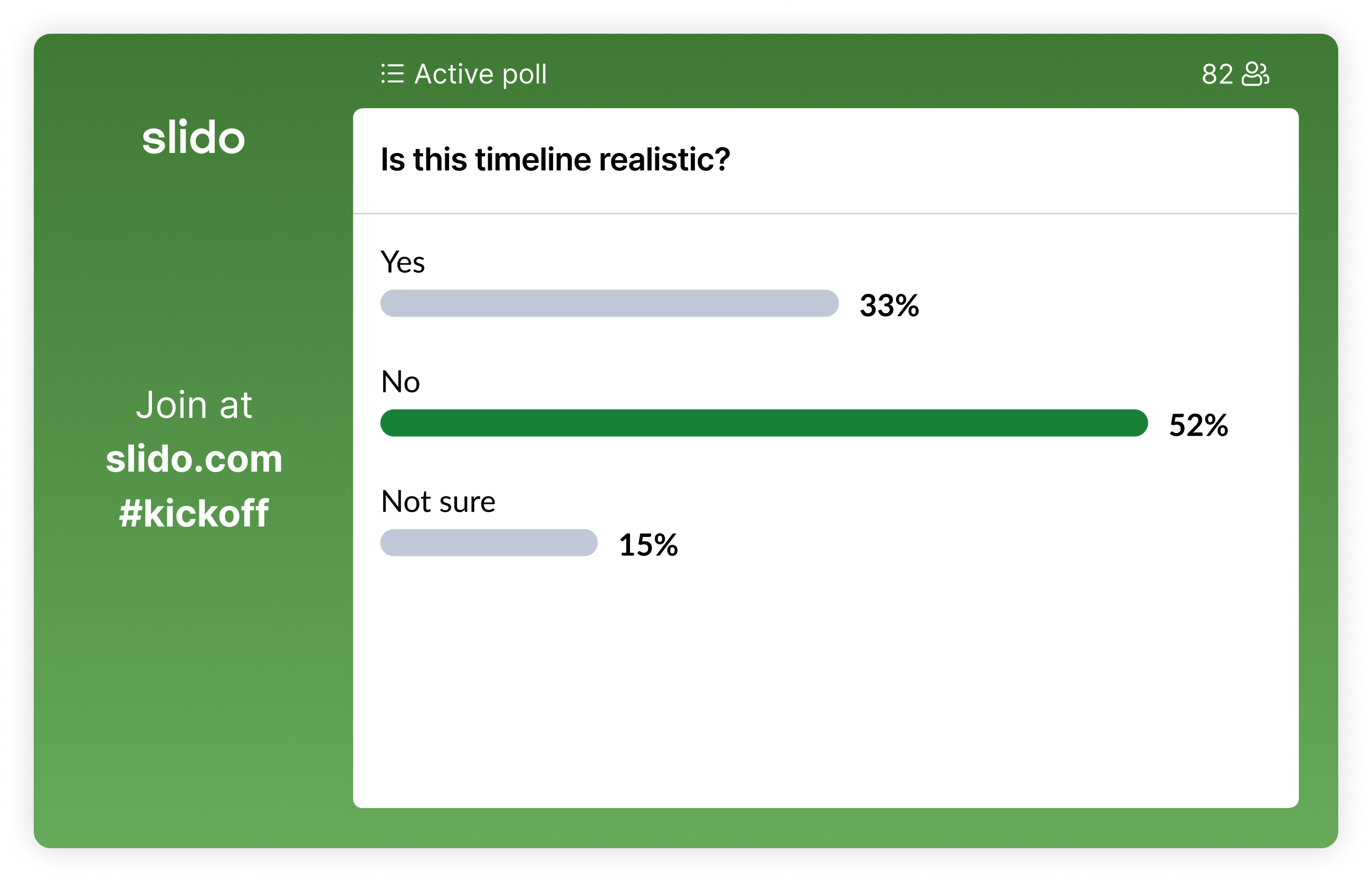
You don’t have to wait until the end to check whether everyone is on the same page. Use quick polls throughout the meeting to see what your team thinks about important parts of the plan.
For example, after presenting the project timeline, ask a yes/no question: “Is this timeline realistic?”
If some participants vote “No”, use the results to open a discussion and find out what’s behind their concerns.
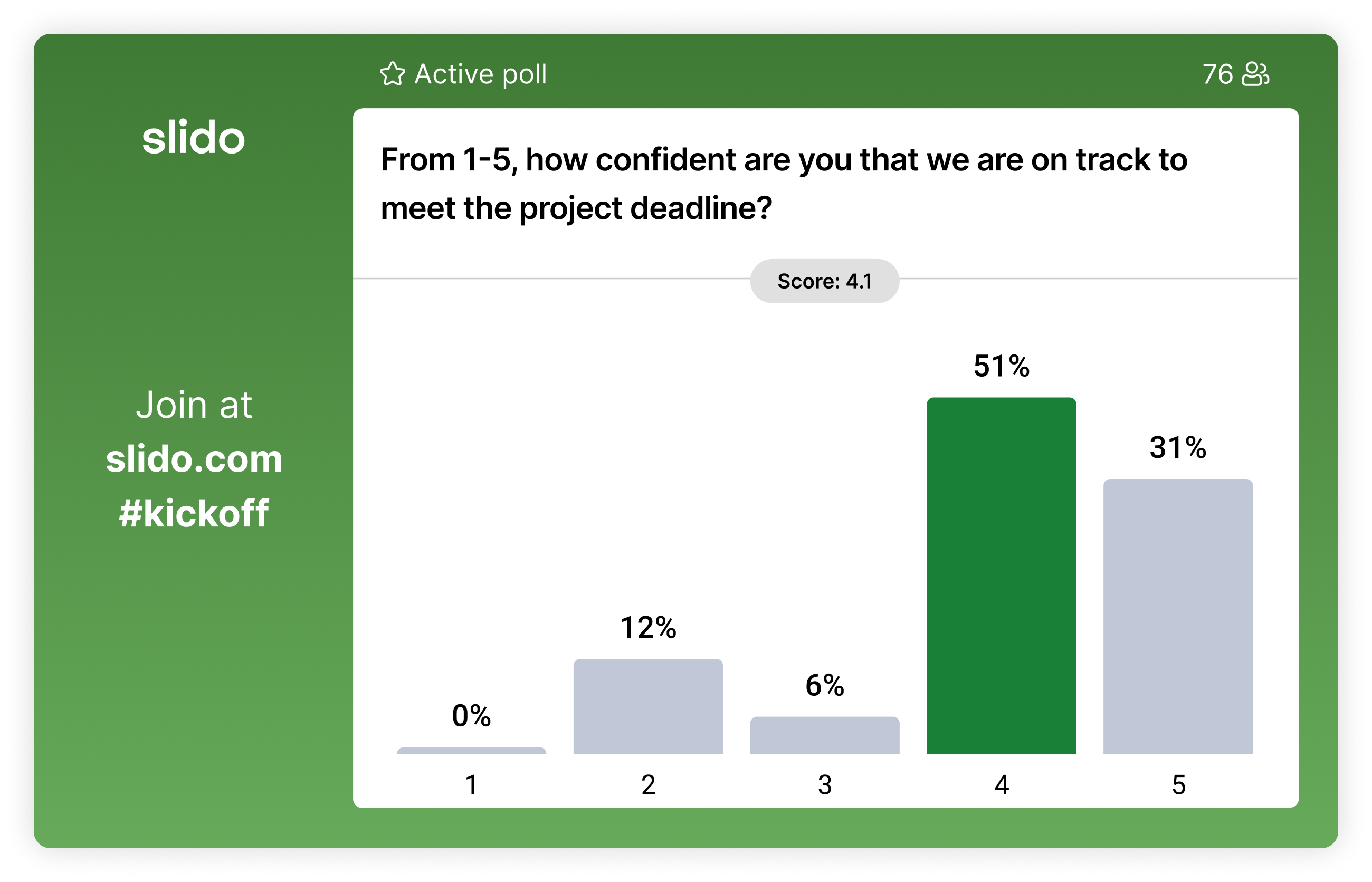
You can use similar pulse checks after discussing the project’s scope, deliverables or roles. Even a simple rating question like “How clear are you on the responsibilities we’ve just outlined?” can uncover issues that need your attention.
💡 Tip
If you run out of time and there are still questions left unanswered, don’t let them hang in the air. Answer them after the meeting in writing and share the answers with your teammates.
Ready to kick off your next project?
A successful kick-off meeting is one where everyone leaves knowing what you’re trying to achieve, how you’ll get there and what they need to do next.
Getting there requires more than presenting a project plan. Give your teammates opportunities to contribute, challenge assumptions, identify risks and participate in the decisions that will shape the work ahead.
With Slido’s live polls, Ideas and Q&A, you can make these interactions a natural part of your kick-off meeting without complicating the facilitation.
So, before your next project begins, spend less time perfecting your presentation and more time planning the conversations you want your team to have. Those conversations are what will help turn your project plan into a shared commitment.
Try Slido for free and make your next project kick-off more interactive, collaborative and productive.